
Quick answer: A statement of purpose for a scholarship is a 500-1000 word essay that explains your academic goals, why you deserve funding, and how the scholarship will help you achieve them. Unlike a general SOP, it must connect your story to the scholarship’s mission and show clear evidence of merit or need.
By reading this blog carefully from start to finish, you will learn:
- What is an SOP for scholarship?
- How to Write SOP for Scholarship?
- Letter of Intent for Scholarship Sample PDF
What is a Statement of Purpose for Scholarship?
A statement of purpose for scholarship is a document that you submit when you apply for a college or university admission seeking financial assistance to cover part of your expenditure on the tuition fees. In the scholarship SOP, you will clearly establish:
- Why you deserve the scholarship
- What makes you deserve it more than other applicants
- How you will utilize it
Scholarship SOP vs Personal Statement vs Letter of Motivation
These three documents are often confused. Here is how they differ.
| Scholarship SOP | Personal statement | Letter of motivation | |
|---|---|---|---|
| Main purpose | Prove you deserve funding | Show who you are | Explain why you want this program |
| Needs a merit or financial case? | Yes | Rarely | Sometimes |
| Typical length | 500-1000 words | 500-1000 words | 1 page |
| Tone | Reflective and specific | Personal | Formal and focused |
Scholarship SOP vs General SOP
| Area | SOP for scholarship | General SOP |
|---|---|---|
| Key objective | To show why you deserve funding | To show why you fit the program |
| Word count | Usually 500-1000 words | Up to 1500 words |
| Content | Personal story, challenges, merit, and the impact the scholarship will have | Skills, academic background, and career vision |
| Tone | Personal and reflective | Professional and academic |
| Structure | Follows the scholarship’s criteria | General SOP structure with program-specific customisation |
How to Write a Statement of Purpose for Scholarship: Step by Step
Before you start
- Check your eligibility. Confirm you meet the scholarship’s academic, financial, and nationality requirements.
- Read the instructions. Note the prompt, the word limit, and the format.
- Collect your proof. Gather marks, certificates, project details, and financial documents you can refer to.
What to write in each paragraph
| Paragraph | What goes in it | Words |
|---|---|---|
| 1. Opening | A specific moment or fact that shows your motivation, plus the scholarship name | 80-120 |
| 2. Academic background | 2-3 real achievements (rank, project, award) | 150-200 |
| 3. Need or merit case | Numbers and evidence, not just emotion | 150-200 |
| 4. Why this program and scholarship | Named courses, professors, or scholarship values | 120-150 |
| 5. Goals and use of funds | Short-term and long-term plan, and how you will give back | 150-200 |
| 6. Closing | One confident sentence linked to your opening | 40-60 |
Total: about 600-800 words, unless the scholarship gives a different limit.
Weak vs. Strong: See the Difference
Example 1: Financial need
- Weak: “I come from a poor family and need this scholarship to fulfil my dreams.”
- Strong: “My father’s income as a bus driver covers our household expenses but not the ₹4 lakh annual cost of this program. A scholarship would let me focus on my studies instead of working two part-time jobs.”
- Why it works: It uses facts, not just emotion.
Example 2: Achievement
- Weak: “I am a hardworking student with good marks.”
- Strong: “I ranked 3rd among 120 students in my department and led a team of four that built a low-cost water testing kit, which won first prize at our college fair.”
- Why it works: It has numbers and proof.
Example 3: Career goal
- Weak: “I want to do great things in the future.”
- Strong: “After this course, I plan to work in public health research in Kerala and develop affordable screening programs for rural clinics.”
- Why it works: It is specific and realistic.
Statement of Purpose for Scholarship Sample
As a first-timer, you may want to see a real-life scenario of writing a scholarship SOP. This statement of purpose for scholarship sample pdf is meant to do that. Go through it carefully.
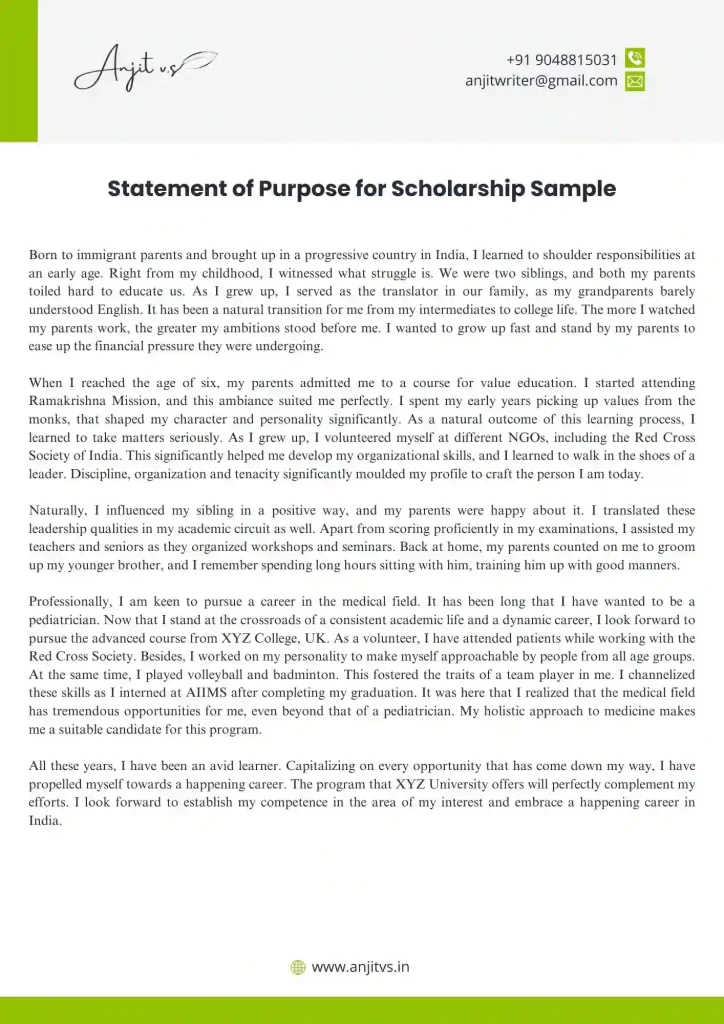
Born to immigrant parents and brought up in a progressive country in India, I learned to shoulder responsibilities at an early age. Right from my childhood, I witnessed what struggle is. We were two siblings, and both my parents toiled hard to educate us. As I grew up, I served as the translator in our family, as my grandparents barely understood English. It has been a natural transition for me from my intermediates to college life. The more I watched my parents work, the greater my ambitions stood before me. I wanted to grow up fast and stand by my parents to ease up the financial pressure they were undergoing.
When I reached the age of six, my parents admitted me to a course for value education. I started attending Ramakrishna Mission, and this ambiance suited me perfectly. I spent my early years picking up values from the monks, that shaped my character and personality significantly. As a natural outcome of this learning process, I learned to take matters seriously. As I grew up, I volunteered myself at different NGOs, including the Red Cross Society of India. This significantly helped me develop my organizational skills, and I learned to walk in the shoes of a leader. Discipline, organization and tenacity significantly moulded my profile to craft the person I am today.
Naturally, I influenced my sibling in a positive way, and my parents were happy about it. I translated these leadership qualities in my academic circuit as well. Apart from scoring proficiently in my examinations, I assisted my teachers and seniors as they organized workshops and seminars. Back at home, my parents counted on me to groom up my younger brother, and I remember spending long hours sitting with him, training him up with good manners.
Professionally, I am keen to pursue a career in the medical field. It has been long that I have wanted to be a pediatrician. Now that I stand at the crossroads of a consistent academic life and a dynamic career, I look forward to pursue the advanced course from XYZ College, UK. As a volunteer, I have attended patients while working with the Red Cross Society. Besides, I worked on my personality to make myself approachable by people from all age groups. At the same time, I played volleyball and badminton. This fostered the traits of a team player in me. I channelized these skills as I interned at AIIMS after completing my graduation. It was here that I realized that the medical field has tremendous opportunities for me, even beyond that of a pediatrician. My holistic approach to medicine makes me a suitable candidate for this program.
All these years, I have been an avid learner. Capitalizing on every opportunity that has come down my way, I have propelled myself towards a happening career. The program that XYZ University offers will perfectly complement my efforts. I look forward to establish my competence in the area of my interest and embrace a happening career in India.
 Download Statement of Purpose for Scholarship Sample PDF
SOP for Scholarship Format
Having an SOP for scholarship format in hand will make the writing much easier. Use the below outline to build a powerful SOP.
Introduction: | Start your SOP with a catchy anecdote that shows your passion for the specific higher study program. Connect it to the financial challenges on your way and how getting a scholarship would help you deal with them. |
Body 1: | Why a certain college/university: In the next paragraph, write clearly about your reasons for choosing a particular institute for your higher studies. |
Body 2: | Academic history: Talk about your previous academic background with a special focus on your achievements. If you have received any prizes, mention them. This will help you prove that you are a candidate with great potential. |
Body 3: | Expertise: Write about your expertise in the particular subject you are choosing to study. Explain what you wish to focus on during your course. Such specific detailing will add more weight to your document. |
Body 4: | Future plans: Talk about your future plans. Emphasise what contributions you can make and how you will utilize the knowledge obtained from the academic program. |
Conclusion: | Conclude your statement of purpose by thanking the selectors for taking the time to read your document and considering it for scholarship issuance. Show your willingness for any further correspondence or verification by the scholarship issuing body. |
What Real Scholarships Ask For
Always read the official instructions before you write. Requirements change every year, so confirm the current details on each website.
| Scholarship | What they typically look for | Where to check |
|---|---|---|
| Chevening | Leadership, networking, study plan, and career plan | Official Chevening website |
| DAAD | Motivation tied to your study and career goals | Official DAAD website |
| Fulbright | Academic goals, leadership, and cultural exchange | Official Fulbright website |
| Commonwealth | Development impact and plans to return home | Official Commonwealth Scholarship Commission website |
Types of Scholarships That Require an SOP
- Merit scholarship: highlight academic results, leadership, and achievements.
- Need-based scholarship: show financial circumstances with facts, and how funding will help.
- Academic scholarship: focus on grades, research, and your plan to keep excelling.
- Creative scholarship: show your portfolio and how funding will support your work.
- Minority scholarship: describe your background, community involvement, and contribution to diversity.
- Women’s scholarship: explain obstacles overcome and how you will support other women.
- Athletic scholarship: show sports achievements, teamwork, and how you balance sport and study.
- Community service scholarship: describe your volunteer work, its impact, and your future plans.
Common Mistakes to Avoid
- Repeating your CV. Tell a story instead of listing facts.
- Asking for sympathy. You deserve funding based on merit and need, so state your situation professionally.
- Not naming the scholarship. Show the reader you wrote this for them.
- Using the same SOP everywhere. Rewrite the scholarship-specific parts each time.
- Ignoring the word limit. Going over can lead to disqualification.
- Making claims without proof. Back up every statement with a fact or number.
- Skipping proofreading. Errors suggest carelessness.
Pre-Submission Checklist
- Scholarship name and values mentioned
- Every claim has a fact or number
- Within the word limit
- Goal is specific and realistic
- Plan for using the funds is stated
- Proofread by another person
Conclusion
A strong scholarship SOP is specific, honest, and written for the scholarship in front of you. Use the structure and samples above as a guide, back every claim with evidence, and always write a fresh version for each application.
If you would like an expert to review or write your statement, contact us.
How long should a scholarship SOP be?
Follow the scholarship’s limit. If none is given, 500-800 words is a safe range.
Can I mention financial need?
Yes. State it factually, with specifics, and connect it to your goals.
How is it different from a personal statement?
A scholarship SOP must make a case for funding and tie it to the scholarship’s purpose.
Can I reuse the same SOP for different scholarships?
You can reuse the structure, but rewrite the scholarship-specific parts each time.
Should I use AI to write my SOP?
AI can help with structure and editing, but the story and facts must be yours, and many scholarships value authenticity.
When should I submit?
Well before the deadline, so you have time to revise.