
Expert Dissertation Data Collection Help – We Deliver Verified Data for Your Projects
- On-time service delivery for tight deadlines
- Advanced tools and methods for data collection
- Delivers verified data sources and datasets
- Tight confidentiality and security for the data

Highlights of Our Dissertation Data Collection Services
Professional Data Collection for Dissertation
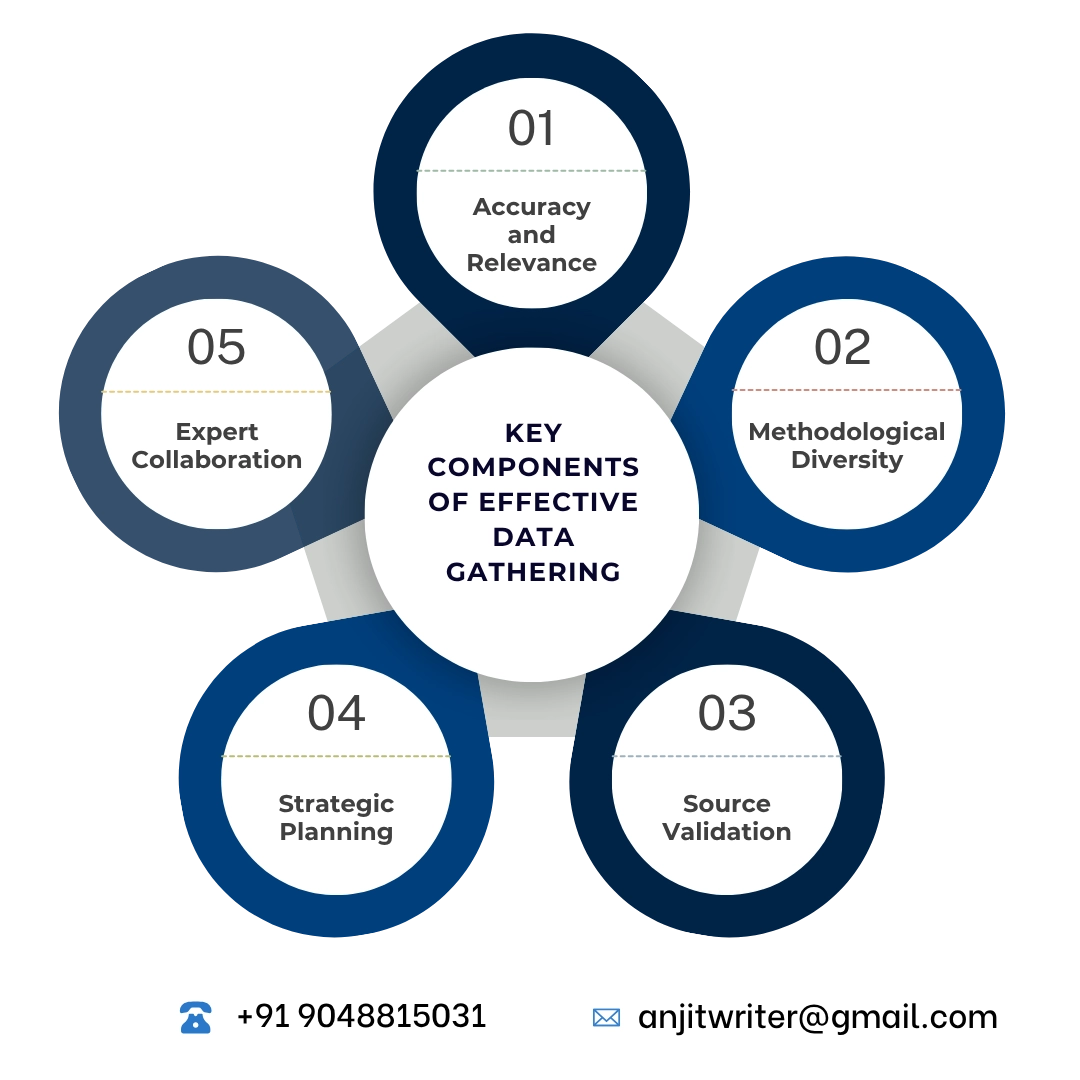
When you prepare a dissertation for your graduate, postgraduate or doctoral program, the accuracy of the data you supply through your presentation is seriously evaluated. If the data has no trace of reality or relevance, it could be judged as superfluous, generic and not accurate. Data collection in dissertation is a process of gathering relevant data for the paper.
Students, depending on the project’s needs, rely on primary (surveys, interviews, etc.) or secondary (media, books, etc.,) or mixed (combining both) sources for data. However, for most projects, finding the relevant sources of data appears challenging. Expert dissertation data collection help could solve this challenge by being precise, resourceful, and focused on delivering data that strengthens the dissertation’s credibility and depth.
Why Choose Anjit VS and Team for Professional Dissertation Data Collection Help?
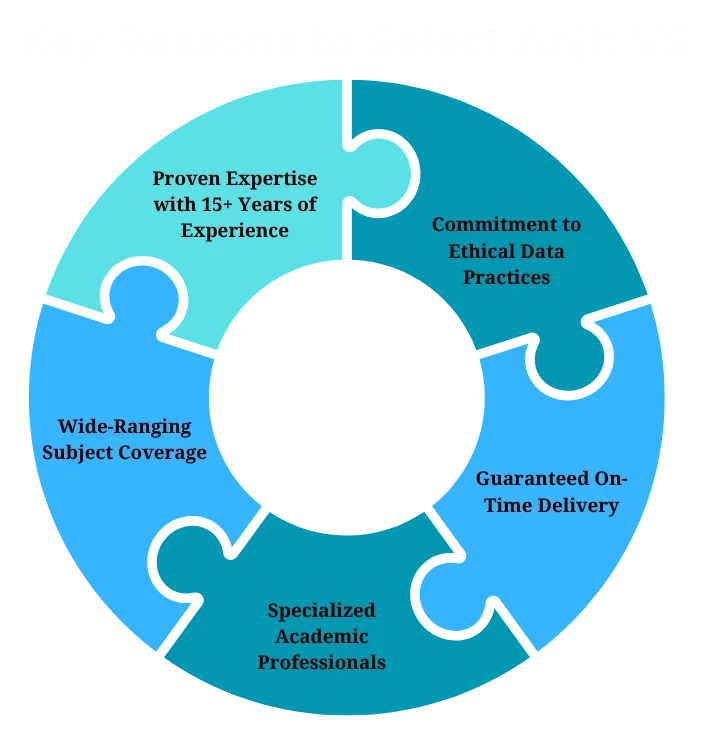
Anjit VS and Team is a highly authentic dissertation data collection help services. As an academic writing service, we have over 15 years of experience. As data collection is a significant part of our processes, we have given special attention to improving the methods. Discover why choosing our dissertation data collection services would be a smart move for students.
Ethical data practices:
At Anjit VS Dissertation Writing Service, we strictly emphasise using ethical data collection methods. We assure that you will be able to present them with confidence.
Timely project delivery:
At no point will you need to worry whether you can submit your paper on time, as our timely project delivery ensures you meet every deadline without stress.
Expert academic team:
Our team consists of experts for data collection. Hence, without compromising on the data quality, we can give you the best output.
Multidisciplinary coverage:
We can offer subject-specific dissertation data collection help as we have a multidisciplinary team ready to help. We have covered 200+ distinguished disciplines.
Types of Dissertation Data Collection Help Our Team Has Expertise In
As we help students in dissertation writing for diverse subjects, academic levels and institutions, we have often been required to use various data collection methods for dissertation. Feel free to approach our team for any type of data collection, including:
Primary Data Collection Methods
- Interview
- Questionnaire
- Focus Group Discussion
- Participatory Rural Appraisal/ Assessment (PRA)
- Rapid Rural Appraisal/ Assessment (RRA)
- Observation Method Survey Method
- Case Study Method Diaries Method
- Principal Component Analysis (PCA)
- Activity Sampling Technique Memo Motion Study
- Process Analysis
- Link Analysis
- Time and Motion Study
- Experimental Method
- Statistical Method
- Epidemiology
Secondary Data Collection Methods
- Published Printed Sources
- Books
- Journals /periodicals
- Magazines & Newspapers
- Published electronic
- sources
- Weblogs
- Unpublished Personal
- records
- Government Records
- Census / Population
- Statistics
Hire Our Experienced Dissertation Data Collection Helper to Ace Your Project!

Subjects for Which You Can Get Dissertation Data Collection Services from Us
We have experienced professionals, advanced knowledge and expertise to carry out academically sound data collection across multiple disciplines. Some of the top subjects we have assisted students with recently include:
Dissertation Data Collection Process
At Anjit VS, we follow a systematic and research-oriented dissertation data collection process to ensure the accuracy, reliability, and academic validity of every research project. Our experts assist students and scholars throughout each stage of the research workflow, from understanding the dissertation topic to validating the collected data for final analysis.
Topic Understanding
The first step in dissertation data collection is understanding the research topic in detail. Our experts carefully analyse the dissertation subject, research problem, academic discipline, and university guidelines to identify the exact data requirements of the study. This stage helps in building a strong foundation for the entire research process and ensures that the data collection methods align with the dissertation objectives.
Research Objective Identification
Once the topic is understood, we identify the key research objectives, research questions, and hypotheses of the study. Defining clear objectives is essential because the entire data collection process depends on what the researcher intends to investigate, measure, or evaluate. This step helps in determining the type of data needed, whether qualitative, quantitative, or mixed-method research.
Selecting Research Methodology
Choosing the appropriate research methodology is one of the most important stages in dissertation data collection. Based on the nature of the research, our experts help students select suitable methodologies such as qualitative research, quantitative research, or mixed methods research. We also assist in choosing suitable research approaches, including case study research, phenomenology, grounded theory, experimental research, cross-sectional studies, and longitudinal studies.
A proper sampling framework ensures that the collected data accurately represents the target population. Our professionals assist students in selecting suitable sampling techniques such as random sampling, stratified sampling, convenience sampling, purposive sampling, and snowball sampling. We also help determine the ideal sample size required for dissertations, theses, and research projects to maintain research validity and reliability.
Effective research instruments are essential for collecting reliable dissertation data. Our experts design structured questionnaires, surveys, interview questions, and focus group discussion frameworks based on the research objectives. We ensure that the research instruments are academically appropriate, unbiased, and aligned with university research standards. We also support online survey creation using tools such as Google Forms, SurveyMonkey, and Qualtrics.
Before conducting the actual data collection, pilot testing is carried out to evaluate the effectiveness of the questionnaire or interview structure. This stage helps identify unclear questions, response issues, technical problems, or research bias. Pilot studies improve the reliability and validity of the dissertation research by refining the data collection instruments before large-scale implementation.
Once the research instruments are finalized, the actual data collection process begins. Depending on the dissertation requirements, our experts assist with primary data collection methods such as surveys, interviews, observations, and focus groups, as well as secondary data collection from journals, research databases, government reports, and scholarly publications. We ensure systematic and ethical data gathering procedures for MBA dissertations, PhD theses, nursing dissertations, engineering research, and management studies.
After collecting the responses, the data undergoes validation to ensure accuracy, consistency, and authenticity. Our research professionals verify incomplete responses, duplicate entries, inconsistent answers, and invalid data patterns. This process helps maintain high-quality research standards and improves the credibility of the dissertation findings.
Raw research data often contains missing values, duplicate responses, formatting inconsistencies, or irrelevant information. Through data cleaning and preprocessing, we organise and prepare the dataset for statistical analysis using tools such as SPSS, Microsoft Excel, NVivo, and AMOS. Proper data cleaning enhances the reliability of hypothesis testing, thematic analysis, and statistical interpretation.
Ethical compliance is a crucial part of dissertation data collection. Our experts ensure that all research activities follow academic ethics and institutional guidelines, including informed consent, participant confidentiality, data privacy, and voluntary participation. We also help students address ethical approval requirements and minimise research bias, ensuring that the dissertation maintains academic integrity and research authenticity.
Quantitative vs Qualitative Data Collection
| Quantitative Data Collection | Qualitative Data Collection |
|---|---|
| Focuses on numerical data | Focuses on opinions and experiences |
| Uses surveys and structured questionnaires | Uses interviews and focus groups |
| Suitable for hypothesis testing | Suitable for thematic analysis |
| Large sample sizes | Smaller targeted samples |
| Statistical analysis using SPSS or Excel | Interpretative analysis using NVivo |
| Objective and measurable findings | Detailed and descriptive insights |
Testimonials

Dissertation Data Collection Tools
Our dissertation data collection services involve advanced research and statistical tools that improve the efficiency and accuracy of academic research.
Online Survey Tools
We assist students in creating professional online surveys using:
These platforms help collect large-scale responses efficiently and securely.
Statistical Analysis Tools
For quantitative research and hypothesis testing, we support:
These tools are widely used for regression analysis, correlation analysis, ANOVA, factor analysis, and data interpretation.
Qualitative Research Tools
For qualitative dissertation research, our experts use:
NVivo helps organise interview transcripts, thematic coding, and qualitative data interpretation.
Dissertation Research Methodologies We Support
Our experts provide dissertation data collection support for various research methodologies, including:
- Qualitative Research
- Mixed Methods Research
- Longitudinal Research
- Action Research
- Quantitative Research
- Case Study Research
- Experimental Research
- Cross-Sectional Research
- Grounded Theory
- Phenomenology
- Ethnographic Research
- Descriptive Research
Need Timely Dissertation Data Collection Help Online? Get in Touch with Us Today!
Frequently Asked Questions
What is data collection in dissertation?
Data collection for a dissertation refers to the process of collecting relevant data to prove or substantiate the core arguments in a dissertation.
How can one collect data for a dissertation?
The data can be collected either via primary methods like conducting interviews or through secondary methods like books, media, etc. or using both.
What do you mean by qualitative data in a dissertation?
Qualitative data in dissertation refers to non-numerical data you intend to use to define or show the quality or meaning of a concept you want to describe in your paper.
What qualifications do your dissertation writers have?
At Anjit VS, we have highly efficient dissertation writers who are qualified with master’s and PhD. Besides the qualification, we train our writers to stay up to date on emerging academic standards and trends as well as subject developments.