
Have you ever started an assignment without fully understanding what type it is?
If you are aiming to submit a winning assignment, understanding the exact type (essay, research paper, oral presentation, reflection or presentation) is important to meet the requirements as expected, which in itself equals to 50% of the work. In this blog, we will walk you through the different types of assignments asked in the academic context.
Why Does Understanding the Types of Assignments Matter?
Understanding the types of assignments matters because each one has a distinct academic purpose. The tone, structure, and approach to an assignment have to be decided based on the structure.
For example, when you write a case study, it has to be in a formal, analytical, and objective tone, as you are acting as an external expert diagnosing a problem. On the other hand, if you are writing a reflective journal, you must write from a subjective and exploratory tone, using first-person language. Here you will connect the theoretical concepts to your own experiences.
Most Common Types of Academic Assignments
Now that you understand why there are different types of writing assignments, let us explore the most common ones you will face during your academic studies.
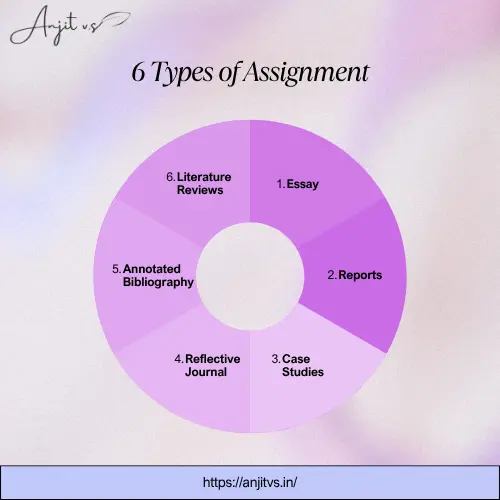
1. Essays (Analytical & Argumentative)
The essay is the most frequently assigned academic task. Its primary goal is to develop a well-reasoned argument and then support that by covering an ample amount of credible evidence.
Structure: In a standard essay, the writer has to include three key essential parts to establish a clear framework: introduction, body and conclusion.
The introduction’s goal is to present a strong thesis statement whereby the core argument is established. The body paragraphs cover the substantiation of the claim with research. We recommend using the PEEL method (Point, Evidence, Explanation, Link) to keep the logical flow of each paragraph to the next. The conclusion must reinforce your argument.
Pro Tip: Your thesis statement is the backbone of your essay. Every paragraph must connect back to it. Strictly avoid adding any new information to the conclusion.
2. Reports (Scientific & Business)
Unlike essays, one must approach the writing of reports differently, as they are supposed to be scanned quickly for key information. You will usually see these types of assignments in Science, Business, and Engineering disciplines, where presenting factual data and findings is critical. Applying a well-balanced mix of tables, numbered subheadings, and appendices can enhance the credibility of a report.
Structure: Write the report with a logical framework starting with an executive summary or abstract that gives a brief of the entire study, followed by an introduction talking about the objectives. Next, tell the nature of your investigative approach in the methodology section. The raw findings of the research are to be placed in the results section, while data interpretation has to go inside the Discussion section.
Pro Tip: Improve readability by using numbered subheadings and bullet points. If the report has to deal with complex datasets, present them in tables, charts, or graphs instead of rough paragraphs. Excessive text slows down the reader’s ability to grasp conclusions at a glance.
3. Case Studies
A case study asks you to bridge the gap between theory and practice. Application of the academic concepts in a specific real-life scenario, person, or organisation is the ideal method to make it impactful. You are expected to think and sound like an expert on the topic.
Structure: A well-crafted case study follows a clear sequence, starting with the background, where the context of the case is established. Then it proceeds by identifying the core issues with the case, analysing them in context and proposing a solution with some practical recommendations.
Pro Tip: Use an objective tone throughout your case study. Avoid simply describing the case and instead focus on diagnosing the root causes and supporting your recommendations with solid evidence and relevant theories.
4. Reflective Journals/Papers
Reflective journals are common writing assignment types in subjects like nursing, teaching, and social work. They ask you to look inward and examine your personal growth. Unlike other academic writing forms, these types of assignments prioritise your subjective experience as a valuable learning tool.
Structure: A reflective paper moves from description of the experience to analysis, where you will examine it through theoretical lenses, and finally to application, where you will outline how this learning will shape your future practice.
Pro Tip: This is one of the few academic contexts where using first-person language (“I felt,” “I observed,” “I learned”) is not only acceptable but also is highly expected. Avoid simply narrating what happened because that will result in being seen as a description rather than a reflection. Instead, therefore, show how your perspective evolved and connect your experiences to academic theories or course concepts.
5. Annotated Bibliographies
Among different kinds of writing assignments, an annotated bibliography stands out due to its status as a foundational assignment for larger research projects. It requires you to critically assess sources before using them in your work.
Structure: Each entry in these kinds of assignments consists of a full citation in the required referencing style (APA, MLA, Chicago, etc.). A concise annotation has to be followed after that, usually a paragraph summarising the source’s content and evaluating its credibility.
Pro Tip: A strong annotation assesses the authority, methodology, strengths, and limitations of the source. Use this opportunity to show your critical thinking by asking: Is this source reliable, or how does it fit into the broader scholarly conversation?
6. Literature Reviews
A literature review is a synthesis of existing scholarly works on a particular topic. Different from an annotated bibliography, which we saw among common types of assignment for students, where individual source listing is the norm, a literature review weaves them together to identify gaps in the research.
Structure: A literature review includes an introduction defining the scope, body sections grouping sources by themes or methods, a critical synthesis of key debates, and a conclusion summarising insights and research gaps.
Pro Tip: Show the reader the current state of knowledge and where your own research will fit within it.
Types Of Academic Assignments at a Quick Glance
| Assignment Type | Core Objective | Central Element |
| Essay | Build a reasoned argument | Thesis statement & supporting evidence |
| Report | Communicate findings clearly | Structured format & visual data representation |
| Case Study | Bridge theory with real-world scenarios | Problem diagnosis & actionable solutions |
| Reflection | Document personal development | Self-assessment & theoretical connections |
| Annotated Bibliography | Assess source quality | Concise summary & critical evaluation |
| Literature Review | Map existing scholarly discourse | Thematic synthesis & identified research gaps |
How To Understand the Prompt and Match Your Writing to The Right Types of Assignments?
In assignment writing, success comes from understanding the prompt correctly and matching the writing approach. To do well in the specific types of assignments in university, you need to pay attention to the directive verbs because they tell you exactly what kind of answer is expected for each assignment.
Examine: Divide a topic into smaller components or sections and explain how they are connected. This approach works well for case studies and essays.
Assess / Review: Look at the strengths and weaknesses of an idea and support your opinion with evidence. Many powerful reports and literature reviews have utilised this style.
Differentiate: If the prompt requires contrasting, focus only on how two things are different, without mentioning similarities.
Integrate: Form one clear and unified argument by combining ideas from different sources. A strong literature review has its core strength from this approach.
Pro Tip: Before you start writing your assignment, highlight the Task Word (the action), the Content Keywords (the topic), and the Constraints (word count/date limits).
Conclusion
So, are you ready to tackle your next assignment? Understanding the types of assignments you are writing is half the work done. Always check your rubric first because from that, you can learn exactly what your professor wants. Best of luck with your assignment writing. Feel free to connect with us if you need any support.