
Are you worried about writing law dissertation? Confused about choosing a topic or understanding what supervisors expect? In this guide, I will show you how to write law dissertation that feels both academically strong and legally persuasive.
How to Write Law Dissertation?
Most students approach a dissertation like an extended assignment. That approach doesn’t work in legal academia. To write a first-class law dissertation, you must stop thinking like a student and start thinking like a legal researcher. Here, I, will break down the processes into a clear roadmap for you. To make it easier for you to understand and apply, I have divided it into four phases.
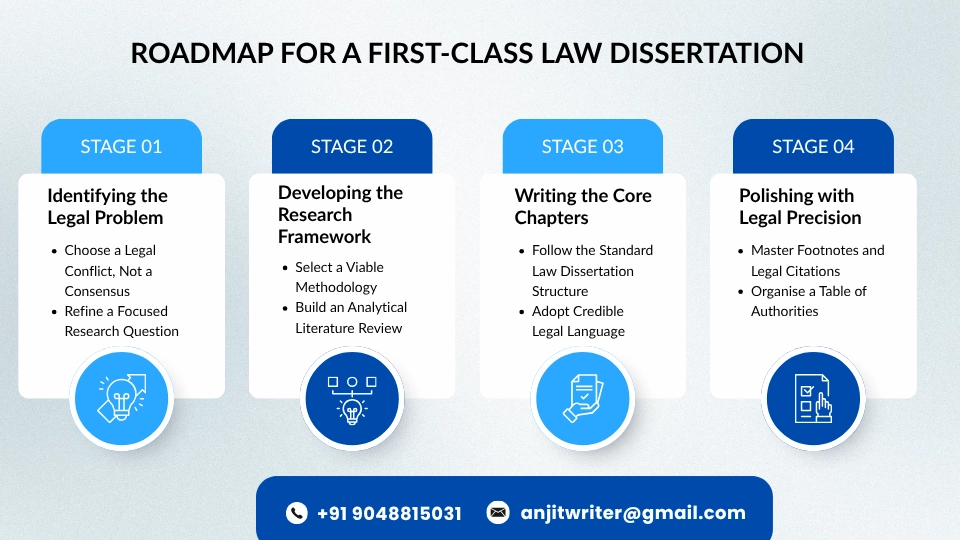
Phase 1: Identifying the Legal Problem
There are two critical steps to take here. One, identifying a law dissertation topic where there is a gap that you can contribute to. Two, framing the research question.
Choose a Legal Conflict Worth Investigating
Do not pick a subject where every judge and scholar agrees. You need a genuine legal conflict. If your research question can be resolved with a straightforward yes or no, it is probably too weak for serious academic research. Focus on areas such as:
- Contradictory rulings delivered by different High Courts or appellate benches.
- Older laws that are facing pressure from modern developments like AI, cryptocurrency, or self-driving technology.
- Legal frameworks that appear effective in theory but fail during real-world implementation.
Refine the Research Question
A broad area of interest is not helpful for strong academic research. You need to shape it into a focused research question. A Study on Human Rights in India, for instance, is a weak research question because it is too general and difficult to analyse in depth.
On the other hand, a research question like ‘How effectively does the Digital Personal Data Protection Act 2023 safeguard minors’ privacy when compared with GDPR standards?’ is more focused. It is specific and limited in scope.
Phase 2: Developing the Law Dissertation Writing Framework
This phase consists mainly of two tasks. One, methodology selection and two, literature review development.
Choose a Viable Research Methodology
I have seen students who proudly say ‘I know how to write a dissertation in law, but are scared away when discussing dissertation methodology. The research methodology is a section where you illustrate how you plan to collect relevant legal data for your research.
Depending on the program’s need, you may opt for comparative or doctrinal research approaches. The former is comparing the law in your specific area of jurisdiction, for instance, India or the UK. The latter is collecting data from existing legal databases or knowledge from the library.
Develop your literature review
When you write a literature review as part of law dissertation writing, keep in mind that it is not merely supposed to be a summary of books and articles. Instead, it has to fulfil the purpose of being a structured analysis of the ongoing academic debate within your legal research context.
Identify the leading scholars and examine how their arguments differ. Organise the discussion according to competing viewpoints or legal interpretations.
Phase 3: Writing Law Dissertation Core Chapters
At phase 3 of our guide on how to write a good law dissertation, let’s see how the actual drafting process has to unfold, how many words each section should have and what the focus should be in each.
Here is the standard format to apply if you wonder how to structure a law dissertation
Introduction (1,000–1,500 Words): Dissertation introduction chapter will introduce the legal issue and then explain the research question. Objective outlining and dissertation roadmap follow.
Chapter 1: Literature Review (2,000–2,500 Words): Here, you analyse the existing academic debate on the legal topic and identify the research gap your dissertation will address.
Chapter 2: The Legal Framework (2,500–3,000 Words): This section is to examine the statutory framework, judicial precedents, and international treaties relevant to your topic.
Chapter 3: Critical Analysis and Evaluation (3,000–4,000 Words): This is the intellectual core of the dissertation. Here, you are supposed to critically evaluate your draft’s weaknesses, contradictions, or doctrinal gaps within the law.
Chapter 4: Reform and Recommendations (1,500–2,000 Words): In this chapter, you may propose reforms, recommendations, or de lege ferenda solutions with the help of your legal analysis.
Conclusion (Around 1,000 Words): Through the final chapter, you summarise all your key findings. Wind up by answering the research question and showing the broader legal significance of your study.
Write With Strong and Credible Legal Language
As you learn how to make dissertation in law, avoid mentioning anything subjective. For instance, ‘I think’ or ‘In my opinion…’. Instead, rely on evidence-based assertions like ‘the available evidence points toward a structural failure in…’
Phase 4: Polishing the Dissertation with Legal Precision
Master Footnotes and Legal Citations
In legal academia, citations carry as much weight as the written argument itself. Maintain complete consistency throughout your referencing style, whether you follow OSCOLA or Bluebook guidelines. Avoid mixing citation formats across chapters.
When referring to judgments, include pinpoint references to the exact paragraph containing the court’s reasoning rather than citing the entire case broadly.
Organise the Table of Authorities
A professionally presented law dissertation should include a properly structured Table of Authorities. Separate case law according to jurisdiction, such as UK, Indian, or EU decisions.
Arrange legislation either alphabetically or chronologically for clarity. The bibliography should also be divided into clear categories, including books, journal articles, government reports, and other academic sources.
Pro-Tips to Write a Distinction-Level Law Dissertation
Curious to know how to write law dissertation that fetches you a distinction? I am excited to share these pro tips with you, which I have acquired over my last decade of experience in law dissertation service.
- Ensure every paragraph directly supports your research question.
- Check recent judgments and legislative updates before submitting your final draft
- Keep one consistent argument throughout every chapter of your dissertation
- Align your conclusion with the promises you made in the introduction.
- Write smaller sections daily instead of delaying to write a perfect full draft
- Remove unnecessary discussion that could weaken your central legal argument.
- Keep your dissertation focused and legally well-structured.
- Review all chapters and see to it that there is logical research continuity.
- Support every claim with reliable legal authorities and evidence.
- Treat dissertation writing as steady progress, not rushed completion.
- Seek expert law dissertation service if your research direction feels unclear.
Conclusion
Well, here we are at the end of this blog.
Now that you have seen the full blueprint for how to write law dissertation in 2026, do you feel more equipped to start your first chapter?
I built these guides from real client struggles.
Tell me what worked for you and what still feels impossible.
Your feedback shapes what I write next.